

When most people hear "bloodborne pathogens," they picture a hospital. That picture tells only part of the story. OSHA's Bloodborne Pathogens Standard (29 CFR 1910.1030) applies to any workplace where workers face a reasonable chance of contact with human blood or other potentially infectious materials. The list of workplaces that must comply with this standard runs longer than most employers expect.
Veterinary clinics, tattoo studios, dental offices, schools, correctional facilities, janitorial services, and even standard business offices — among many others — may all qualify. A manufacturing worker who responds to an injured coworker, a janitor who cleans up after an injury or illness, or a housekeeper who handles soiled linens each faces real exposure risk. Blood and infectious materials can carry diseases such as hepatitis B, hepatitis C, and HIV. These diseases can cause serious illness and even death. OSHA's Bloodborne Pathogens Standard and these tips give employers a clear roadmap to help keep workers safe.
1 Find out whether your workplace falls under the standard.
OSHA's standard covers workers who may reasonably expect to encounter blood or infectious materials while performing their jobs, even occasionally. Walk through every job in your workplace and ask: Could this worker encounter blood or contaminated materials? Document every role and task where the answer is yes, and update that list whenever job duties change.
2 Write an Exposure Control Plan.
Every covered employer needs a written Exposure Control Plan that identifies at-risk workers, describes how the workplace will reduce exposure, and spells out what happens after an exposure incident. Review and update the plan at least once a year.
3 Use controls and safe work practices to reduce exposure.
Provide sharps containers, leak-resistant waste containers, and other engineering controls to remove hazards at the source. Use safe work practices, such as proper cleanup procedures and safe handling of contaminated materials. Workers must never recap contaminated needles with two hands. If recapping is unavoidable, use the one-handed scoop method or a mechanical device designed for holding the needle sheath. Never eat or drink in exposure areas or pick up broken glass with bare hands. Use tongs, a brush and dustpan, or other tools instead. Disinfect contaminated surfaces promptly.
4 Provide the right personal protective equipment (PPE) at no cost to workers.
When engineering controls alone cannot eliminate the risk, gloves, gowns, face shields, and eye protection fill the gap. Employers must supply appropriate PPE free of charge, keep it accessible at the worksite, and ensure workers use it. Employers also must launder, repair, and replace PPE at no cost. Workers with latex allergies must have access to suitable alternatives.
5 Offer a hepatitis B vaccine free to every at-risk worker.
Employers must offer the hepatitis B vaccination series at no cost to employees with occupational exposure within 10 working days of their initial assignment. Explain the benefits of vaccination so workers can make an informed decision about whether to accept or decline it. Hepatitis B can survive on contaminated surfaces for up to seven days — vaccination nearly eliminates that risk.
6 Act fast after an exposure incident.
A needlestick, a splash to the eyes or mouth, or blood contact through broken skin requires immediate action. Wash the site with soap and water right away. Employers must arrange a confidential medical evaluation as soon as possible. For HIV exposure, treatment works best within 72 hours, so don't wait.
7 Train every at-risk worker before they start and every year after.
Training must happen before workers take on tasks that carry exposure risk, and at least annually after that. Cover how bloodborne diseases spread, which workplace tasks create risk, and how to use and dispose of PPE properly. Make sure they know what the Exposure Control Plan says and how to report an exposure incident. Training must take place on the clock, at no cost to workers.
8 Label all biohazard containers correctly.
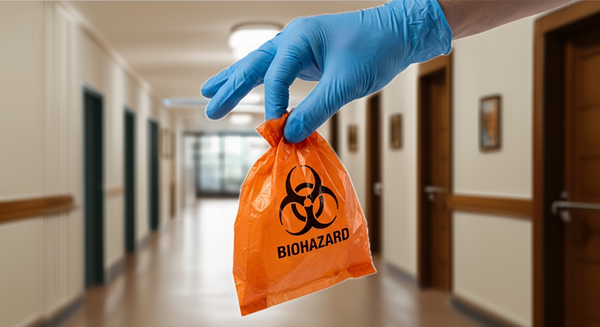
Containers holding blood, other potentially infectious materials, or contaminated sharps must carry the OSHA biohazard label (fluorescent orange or orange-red with a contrasting biohazard symbol). Red bags or containers may substitute for labels. Sharps containers must stay close to the point of use, remain upright, and never overfill.
9 Keep required records.
Medical records, including vaccination status and any post-exposure documentation, must stay on file throughout each at-risk worker’s employment and for 30 years after. Training records must stay on file for three years. Employers who keep an OSHA injury log must also maintain a separate sharps injury log. Medical records are confidential and can be accessed only by the worker, written designees, and officials with legal authority.
Strong policies, proper equipment, effective training, and prompt response procedures can help protect workers, reduce the risk of exposure, and keep your company compliant with OSHA requirements.
For more information, access these DWC resources:
- Bloodborne Pathogens Exposure Control Plan Checklist (English/Spanish).
- Bloodborne Pathogen Exposures Control Plan Sample Written Program (English/Spanish).
- Bloodborne Pathogens Safety Training Program (English/Spanish).
- Bloodborne pathogens safety and health videos.
You can also contact an Occupational Safety and Health Consultant to receive free, on-site help identifying hazards and complying with OSHA standards at 800-252-7031, option 2, or OSHCON@tdi.texas.gov.